
The calendar notification appeared on my screen at 10:23 a.m. on a Wednesday morning in late October.
Subject line: career development conversation. Location: executive conference room. Private attendees: Sienna Whitfield, Co. Scarlett Pierce, human resources director. Me.
I stared at that notification for approximately forty-five seconds before the meaning settled into my bones like cold water. In my thirteen years working at Catalyst Enterprises, a midsized pharmaceutical distribution company, I’d watched this exact sequence play out seven times. The vague meeting title. The closed-door location. The HR presence. It was the corporate equivalent of reading your own obituary before it’s published.
My name is Sadi Barrett. I’m forty-one years old, and for over a decade, I’ve been the person nobody thinks about until everything falls apart. My official title is senior regulatory compliance officer, which is the kind of job that makes people’s attention wander at networking events. I verify that our pharmaceutical shipments meet federal safety standards. I track temperature logs for controlled substances. I ensure our warehouse certifications stay current. I make sure the documentation we submit to government agencies actually reflects reality.
It’s tedious work, unglamorous, the kind of career that doesn’t come with corner offices or company cars. But it’s also the kind of work that keeps a pharmaceutical distributor from losing their DA license when someone with a badge shows up asking uncomfortable questions.
I didn’t panic when I saw that meeting invite. Panic is what happens when something catches you by surprise. This had been building for months—each week adding another brick to a wall I could see coming, but couldn’t stop. So I took a sip of coffee that had gone lukewarm an hour ago, minimized the calendar notification, and went back to finishing a temperature compliance audit that nobody had requested. After thirteen years, muscle memory doesn’t care if the people upstairs have decided you’re disposable. The work continues, because that’s what professionals do.
At 3:47 p.m., I saved my final document, backed it up to my personal cloud storage, and stood from my desk. I’d already packed the photos from my cubicle wall into my bag that morning—not because I’m psychic, but because I understand patterns. When you’ve been around long enough, you learn to read the weather before the storm arrives.
The walk from my desk to the executive conference room took ninety seconds. Long enough to notice the usual office chatter had dropped to whispers. Long enough to see colleagues suddenly become very interested in their computer screens as I passed. Long enough to feel the weight of being the person everyone knows is about to become a cautionary tale.
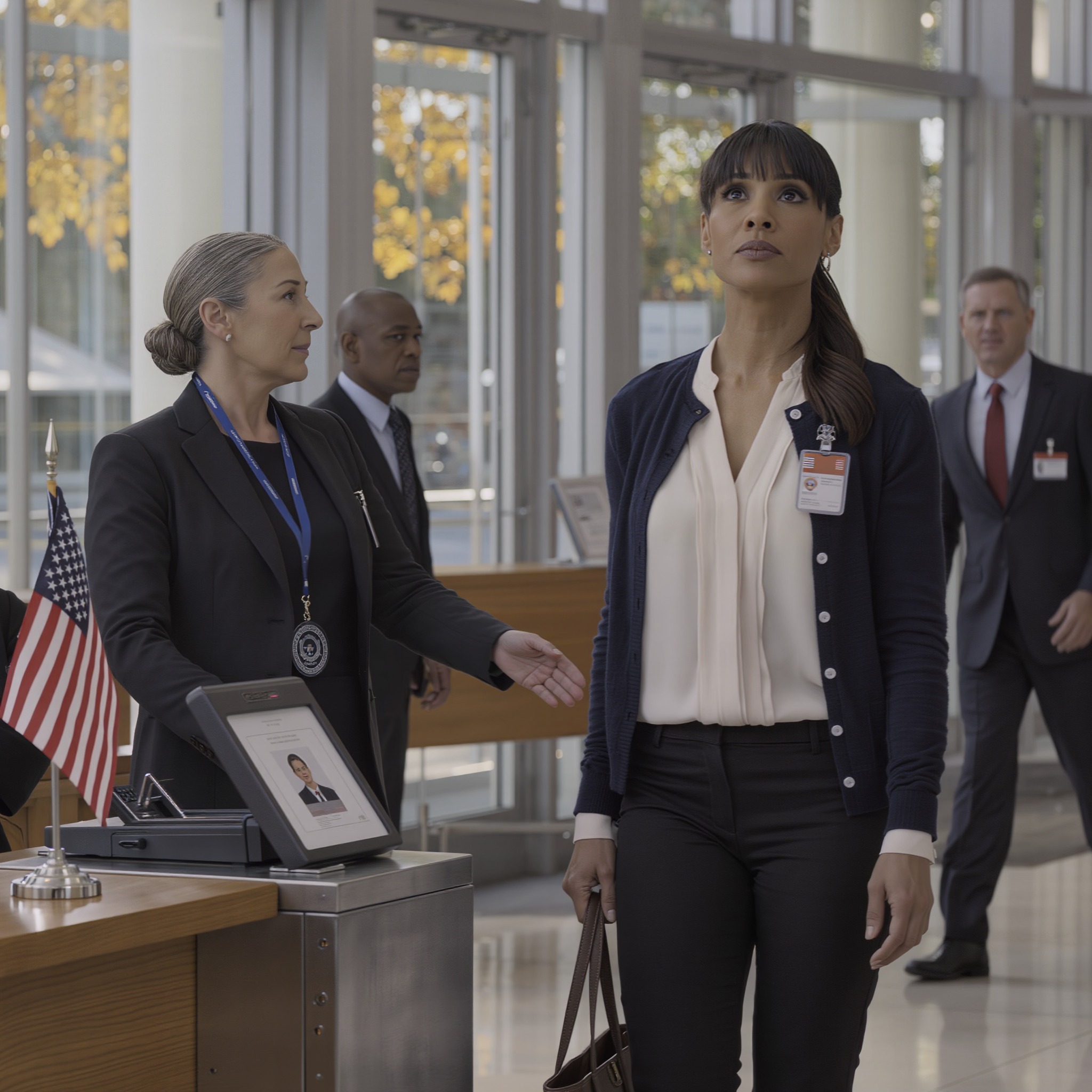
I was halfway down the corridor when I heard it. A sound so mundane most people wouldn’t register it: the mechanical whir of the security badge printer at the front reception desk. It cycled once, paused, then cycled twice more in rapid succession. Three visitors arriving simultaneously, unscheduled.
I slowed my pace and glanced toward the glass partition separating the main hallway from the lobby. Three people in dark suits stood at the security desk—two men, one woman. The woman wore a lanyard with a federal seal I recognized immediately: Department of Health and Human Services, Office of Inspector General. One of the men carried a leather briefcase that looked heavy enough to contain several pounds of documentation.
They weren’t smiling. They weren’t asking the receptionist for directions. They were showing credentials and moving past the security checkpoint with the kind of purposeful stride that doesn’t wait for permission.
The receptionist, a woman named Kelly who’d worked the front desk for six years, picked up her phone with shaking hands. Her voice carried just far enough for me to hear.
“There are federal inspectors here. They’re asking for the regulatory compliance officer. They say it’s urgent. They’re not scheduled.”
My pulse kicked up—not with fear, but with something sharper. Recognition.
I changed direction. Instead of heading toward the executive conference room where Sienna Whitfield was preparing to fire me, I turned toward the main lobby.
The woman with the OIG lanyard saw me approach. She was in her mid-forties, with steel-gray hair pulled back severely and the kind of eyes that had seen every excuse and believed none of them.
“Satie Barrett?” she asked.
“Yes, ma’am,” I said.
She extended a hand. “Special Agent Lydia Hoffman, Office of Inspector General. These are investigators Paul Donovan and Henry Wallace. We’re here to conduct an unscheduled compliance inspection related to your company’s quarterly DA and FDA filings.”
My stomach dropped and soared simultaneously.
“Understood,” I said. “What do you need from me?”
“Everything,” she said. “We need your documentation, your correspondence, your audit trails, and your honest assessment of whether the reports your company submitted to federal agencies over the past six months are accurate.”
Behind me, I heard rapid footsteps. Scarlet Pierce, the HR director, appeared at the edge of the lobby, face flushed.
“Excuse me,” she said, forcing a smile that didn’t reach her eyes. “Can I help you? We weren’t notified of any inspection today.”
Agent Hoffman turned to her with an expression that could freeze gasoline.
“Federal inspections under Title 21 don’t require advanced notification,” she said. “We’re here under statutory authority to examine compliance records. Your cooperation is mandatory, not optional.”
Scarlet’s mouth opened and closed.
“I need to notify RCO,” she managed.
“You do that,” Hoffman said. “In the meantime, we’ll be speaking with Ms. Barrett. I assume there’s a private space available.”
“Conference room three,” I said. “Down this hall, second door on the left.”
Hoffman nodded once. “Lead the way.”
As I walked past Scarlet, I saw her pull out her phone, fingers flying across the screen. I didn’t need to read the message to know what it said. Within thirty seconds, every executive in the building would know federal investigators had arrived unannounced and were currently sequestered with the regulatory compliance officer who was supposed to be fired in thirteen minutes.
Conference room three was small, windowless, and equipped with a table that could seat six people uncomfortably. Hoffman took the head of the table. The two investigators sat on either side. I sat across from them.
Hoffman opened her briefcase and pulled out a thick folder.
“Miss Barrett,” she said, “let me be direct. Three weeks ago, your company filed its quarterly compliance report with the DA regarding controlled substance handling and storage. That report included certifications for temperature monitoring, security protocols, and staff training completion.”
She pulled out a document and slid it across the table. I recognized it immediately: our Q3DA filing. My name was on the certification line at the bottom.
“That’s my signature,” I said.
“Did you personally verify every item in this report before you signed it?” she asked.
I looked at the document—at the neat checkboxes marking everything complete, at the date stamps that looked perfect on paper. Then I looked up at Agent Hoffman.
“No,” I said. “I did not.”
Investigator Donovan leaned forward. “Can you explain that?”
“I can,” I said. “And I will. But first I need to know if you’re recording this conversation.”
Hoffman nodded. “Audio recording only, for documentation purposes. You’re not under investigation, Miss Barrett. We’re here to determine whether your company is in compliance with federal regulations. Your cooperation is voluntary, but it would be helpful.”
“I’ll cooperate,” I said. “But I want it on record that I’m about to tell you things that directly contradict what my employer reported to your agency. And I want it on record that approximately ten minutes ago, I was scheduled to be terminated.”
The three federal agents exchanged glances.
“You were scheduled to be fired today?” Hoffman asked.
“4 p.m.,” I said. “Executive conference room. The meeting invite went out this morning.”
Fletcher, who’d been silent until now, spoke up. “Did your employer give you a reason for the termination?”
“Not officially,” I said. “But I can tell you the real reason. I’ve spent the last four months trying to stop them from submitting false compliance reports. I documented every warning I sent. I have email threads, audit notes, and internal memos showing that I repeatedly flagged violations that management chose to ignore or override.”
Hoffman’s expression didn’t change, but I saw something shift in her posture—interest sharpening into focus.
“Start from the beginning,” she said. “And don’t leave anything out.”
So I did.
I told them about Sienna Whitfield’s arrival six months earlier, how the board of directors had brought her in from a consulting background with instructions to modernize operations and increase efficiency. How her first companywide meeting had been full of phrases like disrupting outdated workflows and empowering teams to move at market speed.
I told them how, within her first month, she’d restructured the entire operations department, bringing in new managers from outside the pharmaceutical industry—people who understood logistics but didn’t understand the regulatory environment that governed every aspect of what we did.
“The first warning sign came in July,” I said. “We were preparing for a routine DA audit of our controlled substance storage. Part of the preparation involved verifying that our temperature monitoring logs were complete and accurate. We store certain medications that require specific temperature ranges. If those ranges are violated, the medications can become unsafe or lose efficacy.”
“What did you find?” Hoffman asked.
“I found seventeen instances over the previous quarter where temperature alarms had been triggered but not properly documented in our logs,” I said. “Each alarm indicated a potential excursion outside the safe range. Protocol requires immediate investigation, documentation, and, in some cases, quarantine of affected inventory.”
“Were those investigations conducted?” Donovan asked.
“No,” I said. “The alarms were acknowledged by warehouse staff, but no follow-up investigations were logged.”
When I brought this to the attention of the operations manager, a man named Eric Sutton, he told me it was a non-issue. He said the alarms were hypersensitive and that the actual temperature variations were minimal.
“What did you do?” Fletcher asked.
“I sent him an email,” I said. “I explained that regardless of whether the variations seemed minimal, federal regulations require documentation of every alarm event and verification that no compromised product entered distribution. I copied my direct supervisor, Lauren Hayes, who reported to Sienna.”
Hoffman made a note. “Did you get a response?”
“I did,” I said. “Eric replied that the warehouse team would be more diligent about documentation going forward. Lauren replied with, ‘Thanks for flagging this. Let’s keep momentum moving.’”
“Momentum moving,” Hoffman repeated, voice flat.
“That became the standard response to everything I flagged,” I said. “‘Keep momentum moving. Don’t slow down the process. Trust the team’s judgment.’”
I told them about the training certification issue in August—how our quarterly DA report required verification that all warehouse personnel handling controlled substances had completed mandatory training modules. How I’d pulled the completion records and found that twelve employees had incomplete training due to a software glitch that had locked them out of the final assessment.
“I couldn’t certify that training was complete when I knew it wasn’t,” I said. “So I sent an email to Lauren explaining the situation and requesting a deadline extension while we got everyone through the final modules.”
“What was her response?” Hoffman asked.
I pulled out my phone, opened my personal email archive, and found the message. I read it aloud.
“Sadi, appreciate the thoroughness, but we’re under pressure to maintain our compliance metrics. Please go ahead and mark training as complete. We’ll cycle the affected employees through a refresher course next quarter. This is a timing issue, not a substantive gap.”
“Did you mark it complete?” Fletcher asked.
“No,” I said. “I replied that marking incomplete training as complete would constitute falsification of federal records. I said I couldn’t sign off on it.”
“How did that go over?” Donovan asked.
“Lauren called me into her office the next day,” I said. “She told me I was developing a reputation for being inflexible. She said Sienna was trying to build a high-performance culture and that I needed to be more of a team player. She said the word technically a lot—as in, technically you’re correct, but we need to be pragmatic here.”
Hoffman’s jaw tightened. “What happened with the training certification?”
“I refused to sign it,” I said. “So Lauren signed it herself. She has signatory authority as the compliance supervisor. The report went to the DA with her signature instead of mine.”
“But your name is on the Q3 report we’re looking at now,” Hoffman said, tapping the document on the table.
“Because by Q3, they’d figured out a workaround,” I said. “Instead of asking me to certify things I knew were false, they started changing the information before it reached me. I’d get a compliance packet that looked complete on paper—all the boxes checked, all the dates filled in. I’d sign off on what I was shown. Then later, I’d discover that the underlying documentation didn’t support what had been certified.”
“Give me an example,” Hoffman said.
I took a breath. “The security audit that’s referenced in the Q3DA filing. The report states that a comprehensive physical security audit of our controlled substance storage was completed on August 19th. It lists my name as the reviewing officer.”
“Was the audit completed?” Fletcher asked.
“No,” I said. “A partial walkthrough was conducted, but the full audit never happened. The security manager, Christine Lopez, told me directly that she’d been instructed to submit a preliminary checklist as if it were a completed audit because the deadline was approaching and leadership didn’t want to report an incomplete status.”
“Did you report this?” Hoffman asked.
“I sent an email to Lauren,” I said. “I said I couldn’t certify a security audit that hadn’t been completed. I requested that we either extend the deadline or report the audit as in progress. And Lauren told me the audit was substantially complete and that I was being pedantic.”
I said she told me that in a growing company, we needed to trust our team leads to make judgment calls. She said if I couldn’t be flexible, maybe I needed to consider whether this was the right environment for me.
The room went quiet for a moment.
“Miss Barrett,” Hoffman said carefully, “are you telling me that your employer submitted federal compliance reports containing information you knew to be false, forged your certification on some of those reports, and threatened your employment when you objected?”
“Yes,” I said. “That’s exactly what I’m telling you.”
Donovan leaned back in his chair. “Can you prove it?”
I pulled my laptop out of my bag. “Every email I sent is archived. Every warning I documented is saved. Every response I received is backed up. I have audit notes showing discrepancies between what was reported and what actually occurred. I have timestamps, names, and specific incidents going back four months.”
I opened my laptop and turned it toward them. “I can show you all of it.”
Hoffman looked at the screen, then at me. “Why did you keep such detailed records?”
“Because I knew this day was coming,” I said. “Maybe not federal investigators showing up, but I knew eventually someone would ask questions. And when they did, I wanted to be able to prove I’d done my job, even if nobody else had done theirs.”
“Smart,” Fletcher said quietly.
Hoffman pulled the laptop toward her. “I’m going to need copies of everything. Can you provide that?”
“I can send you a complete archive,” I said. “Everything is already organized by date and incident type.”
“Do it now,” Hoffman said. “Use my email.”
I spent the next twenty minutes walking them through my documentation: the temperature alarm incidents, the training falsifications, the security audit that was never completed, the batch recall that should have been reported to the FDA but wasn’t because it would have triggered an investigation. With each item, I showed them the email where I’d raised the concern, the response I’d received, and the documentation proving my version of events was accurate.
By the time I finished, all three investigators looked grim.
“Miss Barrett,” Hoffman said, “I want to be very clear about something. What you’ve just shown us constitutes evidence of multiple federal violations. If what you’re telling us is accurate, and if the documentation supports it, your company is facing significant legal and financial consequences.”
“I understand,” I said.
“I also want to be clear about your status,” she continued. “You are not a target of this investigation. Based on what you’ve shown us, you attempted to prevent these violations and were overruled by management. That protects you.”
“What about my termination?” I asked.
Hoffman’s expression hardened. “If your employer attempts to terminate you while we’re conducting this investigation, that becomes retaliation and obstruction. Both are federal offenses. We’ll be making that very clear to your co in approximately five minutes.”
There was a sharp knock on the conference room door. All four of us turned. Through the small window, I saw Sienna Whitfield standing in the hallway, arms crossed, jaw set.
Hoffman stood and opened the door. “Can I help you?”
“I’m Sienna Whitfield, CEO of Catalyst Enterprises,” Sienna said. Her voice had that carefully controlled quality people use when they’re furious but trying to sound professional. “I’d like to know why federal agents are in my building conducting interviews without notifying executive leadership.”
“We don’t require permission to conduct compliance investigations,” Hoffman said. “We’re operating under statutory authority granted by the Controlled Substances Act and the Federal Food, Drug, and Cosmetic Act. Your cooperation is mandatory.”
“I understand that,” Sienna said tightly. “But I’d appreciate being informed when my employees are being questioned.”
“Miss Barrett is cooperating voluntarily,” Hoffman said. “We’re gathering information related to the compliance reports your company has filed over the past six months.”
Something flickered across Sienna’s face—not quite fear, but close.
“I see,” she said. “And has Miss Barrett been helpful?”
“Very,” Hoffman said. “In fact, we’re going to need to speak with you next, along with your operations management team and anyone else who had signatory authority on federal compliance filings.”
Sienna’s composure cracked slightly. “Now?”
“Now,” Hoffman confirmed. “Conference room three will be occupied for the next several hours. I suggest you make yourself available.”
“I have a meeting scheduled for 4 p.m.,” Sienna said.
“Cancel it,” Hoffman said.
Then she closed the door.
Through the window, I watched Sienna stand in the hallway for a moment, visibly processing what had just happened. Then she turned and walked away quickly, heels clicking against the tile floor like a countdown timer.
Hoffman sat back down.
“That’s your CO? That’s her?” she asked.
I said, “And she was planning to fire you in about fifteen minutes, according to my calendar invite.”
“Yes,” I said.
Hoffman pulled out her phone and typed something quickly. “I’m sending a formal notification to your HR department and your CEO. It states that any employment actions taken against you during this investigation will be considered potential retaliation and will be investigated accordingly. That should keep you employed for at least the next seventy-two hours.”
“Thank you,” I said.
“Don’t thank me,” Hoffman said. “Thank yourself for keeping records. Without your documentation, we’d be looking at a lot of he-said-she-said arguments. We have a paper trail that’s going to be very difficult for your employer to explain away.”
Donovan stood. “We’re going to need to interview your colleagues, starting with Lauren Hayes and Eric Sutton. Can you tell us where to find them?”
I gave them office locations. They left to begin pulling people in for questioning.
Hoffman stayed behind, studying me with an expression I couldn’t quite read.
“Off the record,” she said, “how long have you known this was all going to come crashing down?”
“Since July,” I said. “Maybe earlier. There’s a rhythm to these things. When leadership starts prioritizing speed over accuracy, when they start treating regulations as suggestions instead of requirements, it’s only a matter of time before something breaks.”
“Did you ever consider leaving?” she asked.
“Every day for the past four months,” I said. “But if I left, there’d be no one pushing back, no one documenting the problems. And when the inevitable audit came, the company would be able to claim ignorance. They’d say they didn’t know there were issues. But with me here on record, repeatedly raising concerns, they can’t claim ignorance. They can only claim they chose to ignore the warnings.”
Hoffman nodded slowly. “You stayed so you could be a witness.”
“I stayed because someone had to,” I said.
She closed her briefcase. “You’re free to go back to your desk, Miss Barrett. We’ll likely need to speak with you again over the next few days. Keep your phone on.”
I left conference room three and walked back to my cubicle.
The office was in chaos. People huddled in small groups, whispering frantically. Managers hurried past with panicked expressions. Someone from IT was being escorted toward the conference rooms by Investigator Fletcher.
When I sat down at my desk, I noticed the calendar invite for my 4:00 p.m. termination meeting had been deleted. No explanation, no reschedule notice—just gone.
I opened my email. There was a message from Scarlett Pierce in HR, sent at 4:03 p.m.
“Sadi, the meeting scheduled for this afternoon has been postponed indefinitely. Please disregard the previous invitation. We’ll be in touch regarding next steps.”
I read it twice, then archived it.
At 4:47 p.m., Lauren Hayes walked past my cubicle. She looked like she’d aged ten years in the past hour. Her eyes were red. Her hands were shaking. She didn’t look at me.
At 5:15 p.m., Eric Sutton was escorted out of the building by building security carrying a cardboard box. I later learned he’d been placed on immediate administrative leave.
At 6:30 p.m., most of the office had cleared out. The federal investigators were still conducting interviews. I could see them through the glass walls of the conference rooms—taking notes, asking questions, pulling up documents on laptops.
I finished my work for the day, packed my bag, and headed for the parking lot.
As I reached my car, my phone buzzed—an email from an address I didn’t recognize. The subject line said, “From a friend.”
I opened it.
“Sadi, you don’t know me, but I work in accounting. I just want to say thank you. I’ve been watching this place cut corners for months, and I felt crazy for thinking it was wrong. Seeing you stand up to them gives me hope that maybe doing the right thing actually matters. Stay strong.”
I sat in my car for a long moment staring at that email. Then I started the engine and drove home.
The next morning, I arrived at the office at 8:45 a.m. to find the parking lot half empty. At least a dozen employees had called in sick. The grapevine had worked overnight. Everyone knew federal investigators were tearing the company apart, and no one wanted to be the next person called in for questioning.
Agent Hoffman and her team were already there, set up in the largest conference room with boxes of files and multiple laptops. I saw Christine Lopez, the security manager, sitting in one of the smaller conference rooms, looking pale and miserable.
At 9:30 a.m., I received an email from the chief financial officer, a man named Austin Webb.
Subject line: Urgent meeting request.
I walked to his office. He looked exhausted, with dark circles under his eyes and a coffee mug that had been refilled so many times it left rings on his desk.
“Satie,” he said, gesturing to a chair. “Thank you for coming. I know this is a difficult time.”
“Is it?” I asked mildly.
He winced. “Fair point. Look, I’m going to be direct. The board met via emergency session last night. We’ve been going through the documentation that the OIG investigators requested, and we’ve also been reviewing the emails you sent over the past four months. And you were right,” he said, “about everything. The temperature monitoring gaps, the training falsifications, the incomplete audits—all of it.”
“I know,” I said.
He rubbed his face. “Sienna is being terminated effective immediately. Lauren is being placed on administrative leave pending further investigation. Eric Sutton has already been let go. We’re bringing in an outside compliance consulting firm to conduct a full internal audit of every filing we’ve submitted in the past two years.”
“That’s a start,” I said.
“The board wants you to lead the remediation effort,” he said. “Full authority over all compliance operations. Direct reporting line to me and the board. Significant salary increase. Legal protections against retaliation.”
I studied him. “Why?”
“Because you’re the only person in this building who actually understands what compliance means,” he said. “And because the OIG investigators made it very clear that if we don’t fix this immediately and completely, we’re going to lose our DA license. Without that license, we can’t distribute controlled substances. Without that revenue stream, this company folds within six months.”
“So you need me,” I said.
“Desperately,” he admitted. “I’m not going to pretend this is about doing the right thing, Sadi. This is about survival. But that doesn’t mean I don’t recognize that you were trying to protect this company while everyone else was tearing it apart.”
I leaned back in my chair. “I’ll need a few things.”
“Name them,” he said.
“First, I want hiring authority,” I said. “If I’m rebuilding the compliance department, I’m hiring people who understand that regulations aren’t obstacles to work around. Second, I want veto power over any operational decision that impacts regulatory compliance. If I say something can’t be done, it doesn’t get done, regardless of what operations or finance wants. Third, I want quarterly reviews with the board where I present compliance status directly, without any filtering from executive management.”
Austin pulled out a notepad and started writing. “Done. Done and done. What else?”
“I want a formal apology,” I said. “From you, from the board, and in writing. Not because I need it emotionally, but because I want it on record that this company acknowledges it ignored multiple warnings and retaliated against the person who tried to prevent a federal violation.”
He stopped writing and looked up at me.
“You’ll have it by end of business today,” he said.
“Then I’ll take the position,” I said.
He exhaled, looking relieved. “Thank you.”
“Don’t thank me yet,” I said. “You have no idea how much work this is going to take.”
I left his office and went back to my desk. Over the next two hours, I drafted a preliminary audit plan, a list of immediate corrective actions, and a proposal for restructuring the entire compliance department.
At noon, Agent Hoffman found me.
“Do you have a minute?” she asked.
We stepped into an empty conference room.
“I wanted to give you an update,” she said. “We’ve completed initial interviews with your management team. Based on what we found, we’re escalating this to a full criminal investigation. The Department of Justice will be involved.”
My stomach dropped. “Criminal.”
“Knowingly submitting false information to federal agencies is a crime,” she said. “So is retaliating against an employee who reports violations. We have email evidence showing that multiple executives were aware of the inaccuracies and chose to proceed anyway.”
“What happens now?” I asked.
“Now we finish our documentation, compile our report, and refer the case to DOJ,” she said. “That process will take several weeks. In the meantime, your company will be under increased scrutiny—random audits, quarterly reporting requirements, the works.”
“And me?”
“You’re protected,” she said, “both by federal whistleblower statutes and by the fact that you’re a cooperating witness. If anyone tries to retaliate against you now, they’re adding charges to an already serious case.”
She handed me a business card. “My direct number is on there. If anything happens—anything at all that feels like retaliation or intimidation—you call me immediately.”
“Understood,” I said.
She studied me for a moment. “Can I ask you something personal?”
“Go ahead,” I said.
“Why didn’t you go to the authorities sooner?” she asked. “You had documentation of violations for months. Why wait?”
“Because I hoped they’d listen,” I said. “I hoped that if I kept pushing, kept documenting, kept raising the alarm, someone in leadership would wake up and realize what was at stake. I didn’t want to be the person who brought federal investigators down on my own employer. I wanted to be the person who prevented the need for federal investigators, but they didn’t listen.”
Hoffman said—
“No,” I said. “They didn’t.”
She nodded. “For what it’s worth, you did everything right. You tried to fix it internally. You documented every step. You gave them every opportunity to correct course. They chose not to. What happens next is on them, not you.”
She left.
I sat alone in the conference room for several minutes, processing everything. Then I went back to work.
Over the next three weeks, Catalyst Enterprises transformed into something unrecognizable. The federal investigation expanded. More agencies got involved—the DEA, the FDA, the Department of Justice. Investigators became a permanent fixture in the building. Entire departments were placed under review.
Sienna Whitfield was gone by the end of week one. Lauren Hayes resigned rather than face termination. Eric Sutton hired a lawyer and refused to speak to anyone without legal representation present.
The board brought in an interim CEO, a woman named Carolyn Winters, who’d spent thirty years in pharmaceutical compliance and had zero patience for corner cutting. Her first act was to halt all shipments for seventy-two hours while we conducted a comprehensive audit of our inventory and documentation.
“I don’t care if it costs us contracts,” she told the operations team during her first meeting. “I care about not going to prison.”
I was promoted to vice president of regulatory affairs and given an office with actual walls instead of cubicle partitions. My new team consisted of six people I personally recruited from other pharmaceutical companies, all of them with strong compliance backgrounds and zero interest in playing fast and loose with federal regulations.
We spent weeks rebuilding systems that had been broken or bypassed. We implemented new training protocols, new audit procedures, new documentation requirements. We brought in external consultants to verify our work.
We voluntarily disclosed additional violations we discovered during our internal review, because hiding problems was what got us into this mess in the first place. It was exhausting—demoralizing at times, especially when we’d uncover yet another instance of falsified documentation or ignored warnings—but it was also necessary.
Three months after the investigation began, I received a call from Agent Hoffman.
“I wanted to give you a heads-up,” she said. “The DOJ is moving forward with criminal charges. Three individuals are being indicted—your former CEO, your former compliance supervisor, and your former operations manager.”
My breath caught. “Indicted for what?”
“Conspiracy to defraud the United States, making false statements to federal agencies, and obstruction of justice,” she said. “If convicted, they’re each looking at significant prison time and financial penalties.”
“And the company?” I asked.
“The company is facing civil penalties,” she said. “Fines totaling approximately $2,300,000, plus enhanced monitoring requirements for the next five years. But because you’ve been cooperative, and because you’ve implemented substantial corrective measures, the government isn’t pursuing criminal charges against the company itself.”
“That’s something,” I said.
“It’s more than something,” Hoffman said. “In cases like this, companies often get shut down entirely. The fact that Catalyst is surviving is directly attributable to the documentation you provided and the cooperation you’ve offered.”
“I didn’t do it to save the company,” I said.
“I know,” she said. “You did it because it was right. But the result is the same. Your company gets to continue operating. Hundreds of people keep their jobs. And the individuals responsible for the violations are being held accountable.”
She paused. “I also wanted to tell you your case is being used as a training example in our office—what to do when you see violations, how to document them properly, why speaking up matters even when it’s difficult.”
“I appreciate that,” I said.
“One more thing,” she added. “If you ever get tired of private sector work, give me a call. The IG is always looking for people who understand compliance and aren’t afraid to enforce it.”
I thanked her and ended the call.
That evening, I sat in my new office after everyone else had gone home, looking at the stack of corrective action reports on my desk. We’d made progress—significant progress—but there was still so much work to do.
My phone buzzed. A text from an unknown number.
“This is Lauren Hayes. I know you probably don’t want to hear from me, but I wanted to say I’m sorry. You were right about everything, and I was too afraid to admit it. I cost you your peace of mind and almost cost you your career. That’s on me. I hope you’re okay.”
I stared at that message for a long time. Then I deleted it without responding. Some apologies come too late to matter.
Six months after the federal investigation began, I was invited to speak at a pharmaceutical compliance conference in Chicago. The topic was building a culture of compliance in high-pressure environments.
I almost declined. Public speaking wasn’t my strength, and reliving the experience wasn’t something I particularly wanted to do. But Carolyn Winters’s RCO encouraged me to accept.
“People need to hear this story,” she said. “Not the sanitized version. Not the corporate PR version. They need to hear what actually happens when compliance gets treated like an obstacle instead of a foundation.”
So I went.
The conference room was packed—approximately two hundred compliance professionals, all of them with similar stories of being ignored, overruled, or dismissed. I could see it in their faces before I even started speaking.
I told them everything: the ignored warnings, the falsified reports, the retaliation, the investigation, the indictments. I showed them actual emails from my documentation with names redacted. I explained how I’d organized my evidence, how I’d protected myself, how I’d survived.
When I finished, the room was silent for several seconds. Then someone in the back row stood up and started clapping—then another person, then another. Within seconds, the entire room was on their feet.
I stood at the podium, stunned as two hundred compliance professionals applauded. Not because I’d done something heroic, but because I’d done something they all wished they could do. I’d stood my ground when everyone else was demanding I step aside.
After the
News

At my 30th birthday party, my father raised his glass and repeated the joke he’d used for years: that I’d never be able to buy a house, let alone “take care of myself.” Forty people laughed as if it were just a joke. I didn’t argue—I just silently pushed a bunch of keys across the table, and the letter that followed said it all.
At my 30th birthday party, my dad laughed and told everyone, “She’ll never afford a house—she can barely afford lunch.”…
“Mom withdrew the money from this account. I’ve already given it to my wife,” I told my son. “But your wife still needs another $300,000—she’s on her way by taxi,” he snapped. I didn’t argue and prepared a perfect plan to expose the truth of what it really was.
“I am going to withdraw my money from the account. You already gave yours to your wife,” I told my…

My daughter spent $20,000 on my credit card for her husband’s “dream cruise,” then smirked and said, “Mom, you don’t need the money anyway.” I just smiled and told her, “Enjoy yourself.” Then I started planning what would follow.
My daughter spent $20,000 on my credit card for her husband’s “dream cruise vacation.” She smirked and said, “You don’t…
On my wedding day, three empty pew rows told me my family had erased me—but the real blow came when my father returned with deputies, accusing me of stealing my mother’s savings. The wildfire, the missing ambulance, the forged signatures, and the FEMA suspension were only the opening moves. By the time a court panel replayed the footage, one notebook line shattered everything: “Don’t let Danica know.”
On my wedding day, my name—Danica Lel—echoed through a chapel filled with guests. But not a single person from my…
My father mocked me at his $25 million charity gala, calling me a waste of genetics—so I stepped onstage, revealed I control the state grant he needed, and calmly read his budget line by line to the stunned donors. By the time he realized the “dignity center” was really a vanity project, every receipt was already saved, every promise unraveled, and his spotlight turned into an investigation.
“Ladies and gentlemen, meet my daughter. “A total waste of good genetics.” That was the first thing my father said…
End of content
No more pages to load